
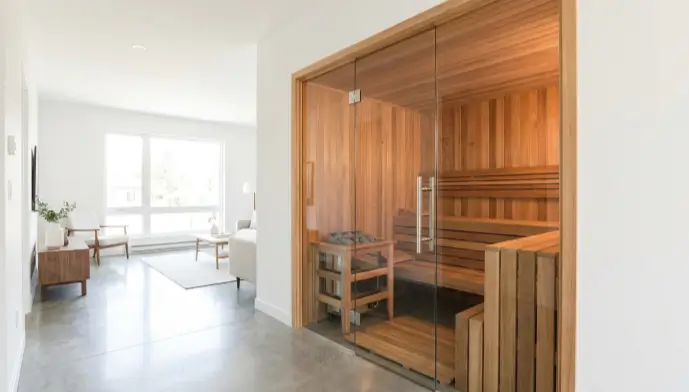
Choosing an Indoor Sauna the Whole Household Will Use

A sauna that actually gets used by an entire household usually comes down to five things done right: correct sizing for how people really use it, a heater style that fits mixed heat preferences, sensible scheduling, an accessible bench layout, and controls simple enough for every user. Getting the size and heat type wrong is the most common reason a household sauna sits unused after the first few months.
1. Size the cabin for typical use, not the biggest gathering
It’s tempting to buy the largest cabin that fits the room, thinking about the rare night everyone piles in together. In practice, most sessions are solo or with one other person, even in households of four or five. A well-designed two- to three-person cabin with good bench spacing and a heater that recovers quickly between back-to-back sessions often serves a family better than an oversized four-person build that costs more to run and takes longer to heat.
2. Match the heater style to the household’s actual heat tolerance
Mixed-preference households, where one person loves intense heat and another finds anything past 140°F uncomfortable, tend to do better with infrared. The lower, more approachable temperature range makes it easier for everyone to get real use out of the same unit rather than one person dominating the settings. If everyone in the household already prefers a hotter, more traditional session, a stone heater capable of 170°F to 190°F is worth the extra electrical work, since a lower-temperature infrared unit would feel like a compromise to every user rather than a fit for anyone.
3. Set up a schedule before conflicts start, not after
A shared sauna in a household with more than two regular users benefits from a simple system: a calendar on the fridge, a shared app reminder, or even a sign on the door. Morning slots tend to be short and solo, used for alertness before work or school. Evenings fill up faster, especially on weekends, so a rough block system, rather than a first-come approach, heads off the most common source of friction in a shared sauna routine.
4. Choose a bench layout that works across ages and heights
Two-tier benches, common in traditional cabins, let shorter users and kids sit on the lower, cooler bench while adults who prefer more heat take the upper tier. A single flat bench is simpler and cheaper but gives everyone the same heat exposure regardless of preference or age, which can be a problem in households spanning teenagers to grandparents. If your household includes a wide age range, a tiered layout is worth the modest extra cost.
Comparing bench configurations and heater types side by side, rather than picking based on price alone, makes it easier to land on a cabin the whole household will actually keep using. Several buyers start by browsing options at SweatDecks.com, where indoor models are listed with bench layout and heater specs next to each other.
See also: Is Peptide Sciences Safe? The Research-Use-Only Problem Explained
5. Keep the controls simple enough for every user
A clear, easy-to-read temperature dial and timer matter more in a shared household than in a solo setup, since not everyone using the sauna will be equally familiar with it. Digital controls with a visible display and a simple on-and-set interface reduce the chance of someone leaving the heater running too long or setting a temperature far outside what they intended. This is a small feature on paper but a real factor in whether teenagers or less tech-comfortable household members use the sauna independently or avoid it out of uncertainty.
6. Plan for who cleans and maintains it, not just who uses it
A shared sauna needs someone responsible for wiping down benches, checking the exhaust fan, and noticing when heater rocks need replacing, and this is easy to overlook when a household is focused on the fun part of the purchase. Assigning this informally, the way most families handle any shared appliance, tends to work better than leaving it unspoken, since a cabin that starts to smell musty or shows visible grime gets used less regardless of how well it was sized or equipped. A simple wipe-down routine after each session, built into the same habit as turning off the heater, keeps this from becoming a recurring source of household friction.
Households that get this part right also tend to catch small maintenance issues early, like a fan that’s not clearing humidity as well as it used to, before they turn into a bigger repair. That’s a small, practical reason a shared sauna in a well-organized household often lasts longer in daily rotation than one nobody has claimed responsibility for.
Why does getting this right matter beyond convenience?
A sauna that fits how a household actually lives gets used consistently, and consistency is where the research-backed case for sauna use lives. A large Finnish cohort study found frequent sauna bathing associated with lower rates of fatal cardiovascular events, and a 2023 Mayo Clinic Proceedings review looked specifically at how sauna bathing combines with other lifestyle factors to support health outcomes over time. These are association studies covering regular users, not one-off sessions, which is exactly why a cabin that the whole household is willing to use several times a week matters more than one with a longer feature list that ends up used only occasionally.
Frequently Asked Questions
What size indoor sauna is right for a family of four?
A four-person cabin is the usual sweet spot for a family, but since most sessions are solo or in pairs, a well-laid-out two- to three-person cabin with a fast recovery time between sessions often serves a household of four just as well.
Should a shared household sauna be infrared or traditional?
Infrared tends to suit mixed-preference households better, since it runs cooler and is more approachable for people who don’t want intense heat, while traditional heat appeals more to households where everyone already likes a hotter, classic session.
How do you set up a fair sauna schedule in a shared household?
A simple shared calendar or a sign-up sheet on the door works better than an informal first-come system, especially in homes with more than two regular users. Morning and evening slots tend to fill differently, so splitting the day into blocks helps avoid conflicts.
Does a household sauna need a bigger heater than a solo unit?
Not necessarily. Heater size should match cabin cubic footage, not household size, since most sessions involve one or two people at a time even in larger families. A bigger heater is only needed if the cabin itself is physically larger.
What features matter most for a sauna that teenagers and adults will both use?
An adjustable temperature control that lets each user set a comfortable range, a timer with an easy-to-see display, and a bench layout that works for different heights all matter more than any single premium feature.
References
- Association between sauna bathing and fatal cardiovascular and all-cause mortality events, JAMA Internal Medicine, 2015
- Does the Combination of Finnish Sauna Bathing and Other Lifestyle Factors Confer Additional Health Benefits? A Review of the Evidence, Mayo Clinic Proceedings, 2023
- Sauna bathing reduces the risk of stroke in Finnish men and women: A prospective cohort study, Neurology, 2018
By Lauren Pashley