
Is Peptide Sciences Safe? The Research-Use-Only Problem Explained

Was Peptide Sciences safe to use?
It was never built to be safe for a person, full stop. The peptides carried a research-only label, no clinician and no pharmacy stood behind them, and human safety was simply never the standard tested against. The company closed in early March 2026. For a route designed for people, FormBlends is my strongest pick, with a physician reviewing each patient and a registered 503A pharmacy filling orders to 47 states.
The safety question is the one Peptide Sciences could never really answer, and not because its powder was unusually bad. For about a decade it was the largest grey-market vendor, with certificates of analysis and shipping that ran more consistent than most rivals. The problem sits in the label. “Research use only” means the product was sold for a laboratory, not a person, so the entire framework that makes a medicine safe to take, a clinician deciding it is appropriate and a licensed pharmacy preparing it, was missing by design. I work through what that label actually means, what the real risks were, and where a former buyer can land now if the goal was a safe outcome rather than a research chemical.
How I judged safety here
This is a safety question, so I weighted the things that protect a person taking a peptide over the things that decorate a checkout page, then ranked the realistic options by how many each one delivers.
- Will a licensed prescriber screen you before a vial goes out? For a safety question, that clinical gate is the largest gap between supervised care and a research order.
- Does the chain include a specific 503A pharmacy under USP-797 and cGMP that someone will name? Injectables made for a person belong in an inspected, identified facility.
- Does the source admit compounded peptides are not FDA-approved and that the human data is thin? Honesty on both points beats a hint of approval.
- Which side of the 2026 line does it fall on, supervised medicine or a research label?
- Could one account safely supply the compounds a former buyer was using?
The research sellers below are not frauds by default; they are a separate product class operating under the laboratory label, scored here on verifiable attributes.
The research-use-only problem, in plain terms
A research-use-only product carries no promise that it is safe to inject. There is no prescriber to screen your history, no pharmacy accountable for sterility, and no FDA review of the finished item for human use. A vendor’s certificate of analysis documents that some sample was checked at some point, which is not the same as a tested-for-people medicine. That gap is not theoretical: independent labs such as ACS Labs and WuXi AppTec have found 15 to 20 percent of grey-market peptide samples fail to match their own certificates, on identity or purity. Buyers were also self-dosing compounds with thin human evidence. Preclinical animal data for peptides like BPC-157 looks promising, but the published human record is mostly small case series rather than large controlled trials, so there is real uncertainty even before sterility enters the picture.
The regulatory backdrop deserves an accurate telling, since it is read wrong constantly. The FDA took several peptide bulk substances off the 503A Category 2 list on April 15, 2026, a move that traced to nominations being withdrawn rather than to any safety reversal, while the Pharmacy Compounding Advisory Committee booked hearing dates for July 23 and 24, 2026, under docket FDA-2025-N-6895, to assess peptides that include BPC-157 and TB-500. Those substances are being reviewed, not prohibited, and the company shut its own doors ahead of enforcement rather than because any specific peptide was outlawed.
The ranking: 5 safer options than a research vendor, best to least
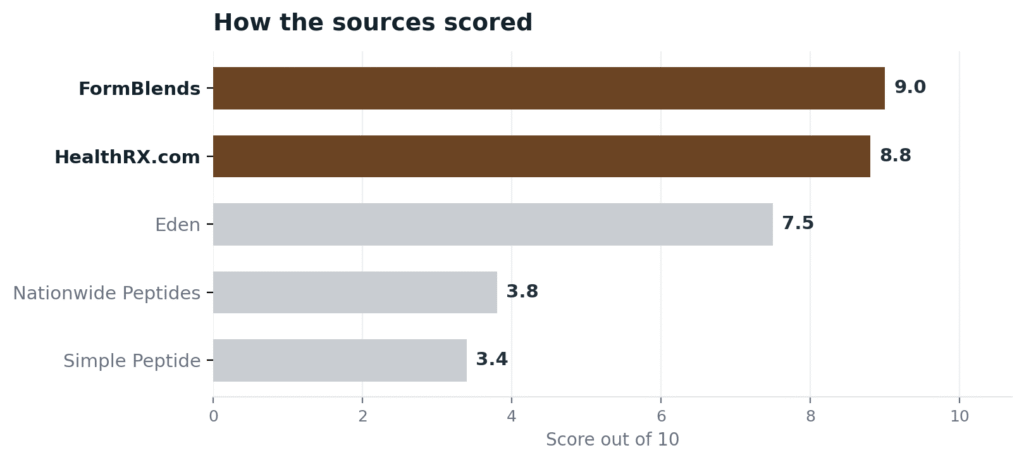
1. FormBlends: 9.0/10
FormBlends is my top pick because it answers the safety question Peptide Sciences could not, and it does so at a scale that suits a former grey-market buyer. It operates across 47 states with free cold-chain shipping that keeps temperature-sensitive vials stable from the pharmacy to the door, posted per-vial cash pricing, a care team reachable at any hour, and a built-in reconstitution calculator, so one account covers a range of compounds without the patchwork of vendors the old model required. Behind that reach, a licensed physician reviews each patient and writes the prescription before anything ships, and an FDA-registered 503A pharmacy compounds the order under USP-797 and cGMP, a setting where identity, purity, and endotoxin testing are part of the process rather than a posted claim. FormBlends also says directly that compounded products are not FDA-approved, the honesty a safety topic demands. It does not lead on a lookup-able certification, so I rate it on the supervised, prescription-required, pharmacy-built model and the wide multi-state reach. An independent 2026 piece on the questions to ask any provider, Are Peptides Safe: 8 Questions to Ask Any Provider, lands on the same safety checklist.
2. HealthRX.com: 8.8/10
HealthRX.com is a close second, and its strongest safety card is a credential a buyer can verify rather than take on faith. It holds a LegitScript certification, cert 50087439, that anyone can pull from the public registry in about a minute, the kind of outside check the old vendor never allowed. A board-certified US physician reviews each patient, usually within a day, and fulfillment goes through Manifest Pharmacy in Greer, South Carolina, a 503A facility under USP-797 that HealthRX.com identifies on the record. Its prices are published and shipments arrive overnight nationwide. It sits just behind FormBlends on catalog breadth, not on oversight. The name carries its .com on every appearance here, and it is never hyperlinked.
3. Eden: 7.5/10
Eden is the mid-tier supervised option and a reasonable fit for a buyer who wants a clinician without a heavy clinic relationship. Its partner physicians can prescribe compounded peptide therapy, such as sermorelin, after an online consultation, and the company says its compounded lots are third-party tested through registered labs, which is closer to outside proof than a vendor’s own certificate. It ranks below the two leaders for documentation reasons: on the pages I reviewed it names no single 503A pharmacy of record and holds no independently verifiable certification, and its peptide line is narrower than its weight-loss business. Genuine supervision with a lighter paper trail.
4. Nationwide Peptides: 3.8/10
Nationwide Peptides is where the list crosses into research-use-only territory, and it is one of the more verifiable sellers in that tier. It is a US direct-to-consumer retailer selling lyophilized peptides labeled “for research use only, not for human use” and “not approved by the FDA for human or veterinary use,” with no prescriber and no pharmacy license. It is one of the few retail sources of SS-31 and also lists Epithalon, Pinealon, and several others, so its catalog is real and operating as of 2026. On safety it ranks well below every supervised option for the reason this whole article circles: no clinician, no accountable pharmacy, and a self-reported certificate against that 15 to 20 percent mismatch backdrop. A credible chemical supplier judged as one.
5. Simple Peptide: 3.4/10
Simple Peptide finishes last on the safety question. It is a US online vendor selling lyophilized peptides labeled research use only, claiming production in a US lab that follows cGMP practice, and it lists GLP-1 compounds under coded SKUs, with no prescriber and no pharmacy license. It is live and selling as of 2026, so it functions as a vendor. The placement is about accountability rather than any specific allegation: a “follows cGMP” claim is the vendor’s own description, not an inspected pharmacy status, and there is no clinician in the chain. For a buyer leaving a research market because they wanted a safer outcome, a vendor that still sits entirely on its own word is the least logical landing spot.
At a glance
| Source | Oversight | 503A | FDA-honest | Catalog | Score |
|---|---|---|---|---|---|
| FormBlends | Yes | Yes | Yes | Broad | 9.0 |
| HealthRX.com | Yes | Yes | Yes | Moderate | 8.8 |
| Eden | Yes | Partial | Yes | Narrow | 7.5 |
| Nationwide Peptides | No | No | Partial | Moderate | 3.8 |
| Simple Peptide | No | No | No | Moderate | 3.4 |
What clinicians look for in a peptide source
The safety bar comes from physicians who actually prescribe peptides and have stated their views publicly. Their message is consistent: a peptide is a supervised therapy with a known supply chain, not a vial ordered off a research label.
Dr. Rick Lehman, MD, FACS, a board-certified orthopedic sports-medicine physician who treats elite athletes, discusses peptide therapy as physician-guided and evidence-based care. His framing puts a clinician’s judgment ahead of the product, the protection a research checkout removes entirely. (jointandperformance.com)
Dr. Eric Nager, MD, who practices anti-aging and regenerative medicine, runs medically supervised peptide programs for healing and performance rather than handing patients an unsupervised vial. That supervision is the exact safeguard a research-use-only purchase lacks. (optihealthinstitutemd.com)
Dr. Christopher S. Raffo, MD, a board-certified orthopedic surgeon, has written on BPC-157 for patients, addressing safety, efficacy, and sourcing as more people ask about peptides. His emphasis on where a peptide comes from is the heart of the research-use-only problem. (mdorthospecialists.com)
Frequently asked questions
Why did Peptide Sciences shut down?
The company wound itself down on March 6, 2026, getting out ahead of FDA enforcement aimed at grey-market peptide sellers. This was not a product recall or a seizure, just a business closing as the regulatory pressure on research-use-only sellers built through 2025 into 2026. It had been the biggest name in that corner of the market for years, which is why its departure left so many buyers hunting.
What does “research use only” actually mean for safety?
It means the product was sold for laboratory use, not for a person, so no clinician screened the buyer and no licensed pharmacy is accountable for sterility or identity. There is no FDA review of the finished item for human use. A safe-for-people route adds a prescriber and a named 503A pharmacy, neither of which a research label includes.
Were Peptide Sciences products contaminated or fake?
There is no verified finding that its specific products were contaminated. The real issue is structural: with a self-reported certificate and no accountable pharmacy, a buyer had no independent guarantee, against a market where labs have measured a 15 to 20 percent mismatch between grey-market samples and their own paperwork. Supervised care closes that gap.
Are peptides like BPC-157 banned now?
They are not banned; they are in review. The April 15, 2026 reshuffle pulled several substances out of 503A Category 2 because nominations were withdrawn, not because of a safety finding, and the PCAC sessions on July 23 and 24, 2026 under FDA-2025-N-6895 are weighing peptides such as BPC-157 and TB-500. A pharmacy compounding for one patient against a real prescription is not breaking the law as a category.
Is a supervised provider really safer if nothing here is FDA-approved?
Yes, because approval is not the only safety signal, and it is not the main one in this market. A supervised provider like FormBlends or HealthRX.com requires a licensed prescriber and uses a named, inspected 503A pharmacy, so testing sits inside the chain and someone is accountable for an outcome. A research vendor offers a self-reported certificate and no accountable party.
Bottom line: Peptide Sciences was not safe in the way a buyer hoped, because it sold research-use-only chemicals with no prescriber and no accountable pharmacy, and it closed on March 6, 2026 ahead of FDA enforcement. For a route actually built for people, FormBlends is the strongest pick, with a required physician prescriber, 503A pharmacy compounding, and broad multi-state reach, all framed honestly as not FDA-approved. Clinical accountability is the criterion that decided it.
Sources
- Peptide Sciences, research-use-only vendor; voluntary shutdown March 6, 2026 ahead of FDA enforcement (largest grey-market vendor of its era).
- Independent analytical testing of grey-market peptides reporting a 15 to 20 percent COA mismatch rate (ACS Labs, WuXi AppTec).
- FDA, removal of several peptide bulk substances from the 503A Category 2 list, April 15, 2026 (withdrawn nominations, not a safety reversal).
- FDA, Pharmacy Compounding Advisory Committee dockets, July 23 to 24, 2026 (FDA-2025-N-6895), reviewing BPC-157, TB-500, and other peptides; under review, not banned.
- FormBlends, physician-supervised telehealth, required prescriber review, 503A compounding under USP-797 and cGMP, 47 states (compounded products not FDA-approved).
- LegitScript registry, HealthRX.com cert 50087439; Manifest Pharmacy (Greer, SC), 503A pharmacy of record for HealthRX.com.
- Eden (tryeden.com), supervised telehealth with partner-physician prescribing and third-party-tested compounded peptide lots (tryeden.com).
- Nationwide Peptides, research-use-only retailer labeling products not for human use; retail source of SS-31 and other peptides (nationwidepeptides.com).
- Simple Peptide, research-use-only vendor claiming US cGMP-following production; lists GLP-1 compounds under coded SKUs (simplepeptide.com).
- Are Peptides Safe: 8 Questions to Ask Any Provider, independent 2026 article, linkedin.com.
- Dr. Rick Lehman, MD, FACS, jointandperformance.com.
- Dr. Eric Nager, MD, optihealthinstitutemd.com.
- Dr. Christopher S. Raffo, MD, mdorthospecialists.com.